Adam Broomberg and Oliver Chanarin photographed forests of the Jewish National Fund (KKL/JNF) in 2005. Behind these idyllic images are the ruins of systematically erased Palestinian villages. Read more about the photo series below this article.
Planting a tree in Israel to commemorate: this is how the Jewish National Fund has been presenting itself to donors for decades, including in the Netherlands. As a tribute to my grandmother and her resistance to the Holocaust, these kinds of trees have also been planted. But behind these forests lies a strategy aimed at expelling Palestinians and making their return impossible, together with the State of Israel.
'Without greenery, there is no life – and Israel has so little greenery. Because for centuries, man and water, wind and sun have wreaked havoc there without mercy.'
It can be read on the certificate of one of the trees planted in Israel as a tribute to my grandmother by the Jewish National Fund in the aftermath of World War II.
I find it in a box between her blue-and-gray striped camp uniform from the Ravensbrück concentration camp, photos of friends with captions about where and when they were gassed, and wafer-thin pieces of toilet paper with hiding addresses. After my grandmother was arrested by the Germans in 1943, she wrote down the names and addresses of children who were in danger in her cell in Amsterdam on sheets of toilet paper. They were smuggled out in hems and stockings by brave women who wore women's skirts.
/Images/2.png)
The JNF tree certificate dedicated to T. Boeke-Kramer
At first glance, the tree certificates are less impressive than the other items in the box. But when I started to find out the story behind those trees, curious about my grandmother's legacy, I discovered a story that was anything but innocent.
This story is about the trees of the JNF. About how an organization that flaunts trees as a symbol of remembrance and gratitude for resistance to the Holocaust, in reality has contributed to the ethnic cleansing of Palestinians, and continues to do so.
If you zoom out even more, you will see that these trees are part of something bigger: how the Dutch have consciously or unconsciously contributed to the origin myth of Israel, which led to unconditional support for that country.
Giving thanks in the 'usual Jewish way': planting a tree
My grandmother, Tine Boeke-Kramer (1919-2018), was 21 when the Second World War started. She became active in the Amsterdam resistance and was involved in the hiding of Jewish children. That went well, until it went wrong. In 1943 she was arrested and deported to camp Vught, concentration camp Ravensbrück and concentration camp Sachsenhausen-Oranienburg. Like most of the children she helped to find shelter and took away, she survived her 'children in hiding'. She maintained a warm contact with many of them throughout her life.
After the war, and sometimes much later, the Jewish National Fund planted trees in Israel in the name of my grandmother in the name of her children in hiding. The first tree planted for her dates from 1950, two years after the founding of the state of Israel and what is called in Arabic the Nakba, or "the catastrophe," in which hundreds of thousands of Palestinians were murdered or expelled from their homeland.
In an accompanying letter, my grandmother is thanked for her help to Liesl Weisz, a Jewish girl she took in herself. 'That's why we offer tree planting in the usual Jewish way.' For the sake of completeness: planting trees is not a specifically Jewish custom, it was created by the JNF itself.
The certificates feature biblical quotes suggesting that the land on which the trees of the JNF are planted was empty, barren and uncultivated. One certificate also states that the trees make Israel "stronger, calmer, safer and happier."
/Images/3.jpg)
The Saints Forest' (2005)
Establishing a Jewish homeland by buying land
The Jewish National Fund in the Netherlands (JNF), is a foundation affiliated with the Israeli KKL/JNF, known in Israel under the Hebrew name Keren Kayemeth LeIsrael. The KKL/JNF was founded in 1901 at the fifth Zionist congress in Basel. The goal of the organization was to establish a Jewish homeland by purchasing land in Ottoman Palestine for Jewish habitation and agriculture.
In Ottoman Palestine, much land was owned by Ottoman landowners, who had already used it before of Palestinian peasants. They allowed the Palestinian farmers, for whom the land was their home and source of income, to lease the land. The KKL/JNF bought lands from those large landowners and summoned the original Palestinian owners to leave. Those who did not leave themselves were chased away.*
After the Balfour Declaration of 1917, the activities of the KKL/JNF grew from small land purchases to a much larger project, which was coordinated in cooperation with the British Mandate in Palestine.* The organization did not speak publicly about living together with the Palestinians at the time. However, in his diary in 1940, director Yosef Weitz wrote: 'There is no room for both peoples in this country. The only solution is an Israel without Arabs."*
After the Second World War, things moved quickly: from the ashes of the Holocaust and the guilt about it, the state of Israel arose. The role of the KKL/JNF changed along with it: now that there was no longer any need to buy land, it started to focus on 'reforesting' Israel.
Planting trees to appropriate land
From a distance, it sounds quite innocent, like a good idea even. Who is against planting trees? Trees provide oxygen, shade and prevent soil erosion. Now that the earth is warming up rapidly, trees are of vital importance.
But behind the so-called reforestation of the KKL/JNF lies a different reality. The vast majority of the land on which the KKL/JNF planted trees from 1948 onwards has been taken by force, according to research by the Israeli non-governmental organization (NGO) Zochrot. While the Jewish paramilitary organizations Haganah and Palmach expelled the Palestinians from their villages, the KKL/JNF took over the management of the land.*
In his book The Ethnic Cleansing of Palestine (2006), the Israeli historian Ilan Pappé shows that documents from the KKL/JNF were used in the large-scale expulsion and murder of Palestinians. It concerns the so-called Village traffic jams, an overview drawn up in 1940 by the KKL/JNF of Palestinian villages with military-strategic points, such as bridges and lookouts, which served to make operations as efficient as possible.*
Between 1901 and 1948, the KKL/JNF had only acquired small pieces of land, about 2 to 3 percent of the area that later became Israel. After the 1948 war, that changed. All Palestinians who had left, fled or expelled from their villages between the end of 1947 and the spring of 1948 were sentenced to the Absentees' Property Law even if they were forced to stay in a refugee camp. Their houses, land and possessions automatically came into the hands of the state of Israel, which administered them as 'custodian of absentee property’. The land was later declared permanent property of the state by Israel.*
This involved huge areas: both within the boundaries of what was assigned to the Jews by the UN, and beyond.* In total, it was half of the new territory of the state of Israel. The state then transferred large parts to the KKL/JNF.
/Images/4.jpg)
According to the NGO Palestine Land Society, the property of the KKL/JNF grew in a short time to about 13 to 19 percent of the extensive Israeli territory.* Trees were planted on this land by them. By planting the land with trees, they were irrevocably claimed and the presence of the former residents was erased.
But the JNF did not limit itself to planting trees. Yosef Weitz, in his role as director of the KKL/JNF, had Palestinian villages destroyed to prevent the expelled residents from returning.* The KKL/JNF also published a booklet with plans to build 130 Jewish settlements on sites where there were Palestinian villages and towns. Weitz was also also responsible for the idea of the 'transfer' of Palestinians:* the organized deportation of Palestinians from Palestine to neighboring countries.
All this shows that the KKL/JNF has actively contributed to the ethnic cleansing of the Palestinians.
/Images/5.jpg)
Rabin Park (2005)
Not environmental protection, but green colonialism
The forests planted by the KKL/JNF were designated by Israel as protected nature. In doing so, Israel erected legal and practical barriers to the return of the former residents.* This practice is known as 'green colonialism': the abuse of environmental protection to erase the indigenous people and appropriate their land.* However, according to a 1948 UN resolution, Palestinian refugees have the right to return or receive compensation. Israel does not recognize this right of return.
What that means in practice, the Dutch former diplomat and writer Erik Ader discovered. For his father, resistance fighter Reverend Ader, a forest was planted after the Second World War. When Erik Ader visited it in 2004, he found the terraces of an olive grove. They turned out to belong to the Palestinian village of Bayt Nattif, whose residents were expelled in 1948.
On the ground of Bayt Nattif, The Kibbutz Netiv HaLamed founded. The Palestinian survivors and descendants of that ethnic cleansing have been living in appalling conditions ever since in the Aida refugee camp near Bethlehem, because they cannot go back.*
On one of my grandmother's certificates, the Joop Westerweel Forest is listed as the location. It is located near Kibbutz Ramat Menashe, in northern Israel. Westerweel was a friend of my grandmother from the resistance. On Google Maps, the kibbutz looks peaceful. I scroll past photos of flowers that would not look out of place in expensive field bouquets, dogs playing with each other in a meadow and in the background a wide forest with conifers. That must be the forest.
Research by Zochrot into the locations where the KKL/JNF has planted and is still planting trees shows that the Joop Westerweel Forest is part of the larger KKL/JNF nature park Ramat Manashe. It is planted on the ruins of several Palestinian villages which were taken by force and destroyed in 1948. About two thousand Palestinians were expelled by the Jewish paramilitary organizations. The survivors and their descendants, now more than ten thousand people, are still displaced and live in refugee camps in Jordan and Lebanon, the West Bank and Gaza.*
When asked whether the Dutch JNF knows that the Joop Westerweel Forest has been planted on destroyed Palestinian settlements, the organization does not respond. It does say: 'JNF Netherlands only supports projects within the current internationally recognized borders of Israel. This project meets that condition.'
A coin from the diaspora to perpetuate the bond with Israel
Those trees that were planted in my grandmother's name appear to have been part of a structural way of taking land for Jewish use, at the expense of the living environment of Palestinians. The KKL/JNF is not just 'a Zionist organization', but a club that has given the Zionist ideology hands and feet. It is ironic that those who stood up against fascism, and in the case of my grandmother had to pay for it with a considerable war trauma, were used to facilitate and conceal ethnic cleansing elsewhere.
The KKL/JNF was financed for its activities by the Israeli state and large funds, and by the diaspora. In post-war Netherlands, the blue collection boxes of the JNF were a familiar sight. In shops, synagogues, sports clubs and people's homes, you could throw a coin in it and thus contribute to the construction of the state of Israel. 'One of the first large-scale successful crowdfunding campaigns', filmmaker Michal Weitz calls it in her documentary Blue Box.
Soon after its establishment, the KKL/JNF and its local branches started actively selling tree certificates worldwide as part of this donation strategy. The Dutch JNF also did this – and still does. The goal of fundraising went beyond the realization of tree plantings: the KKL/JNF attached at least as much – if not more – importance to creating a link between the diaspora and the Jewish state of Israel.*
/Images/6.jpg)
Canada Park (2005)
Planting trees in the desert and taking land in occupied territory
Since its inception, the KKL/JNF says it has planted more than 260 million trees.* The JNF in the Netherlands does not want to make any statements about the exact numbers that have been planted with a financial contribution from Dutch donors.
Not only are there more trees in Israel every year, the KKL/JNF is still expelling Palestinians from their land, Zochrot tells me. 'At the moment, the KKL/JNF is planting trees in the Negev desert. Under the guise of environmental protection and climate restoration, trees are planted that not only destroy the fragile ecosystem of the desert, but also take away the grazing land of the Arab Bedouin peoples.'
Bulldozers of the KKL/JNF drive into the Bedouin villages with police protection and reclaim the land. Those who protest are violently crushed or arrested. Then access to the area is blocked and the Bedouins are banished to townships.
On its website, the Dutch JNF shares information about afforestation projects, including in the Negev desert, to which donors can contribute. This also includes projects with Dutch namesakes. Recently, in collaboration with the Center for Information and Documentation Israel (CIDI), a park in the Negev desert was named after the Dutch formerParool-columnist Theodor Holman, as a token of gratitude for his 'fight against anti-Semitism'.
The Dutch JNF does not directly address the question of whether afforestation projects in the Negev desert financed by the Dutch JNF (co-)financed result in displacement or expropriation. However, the organization says that it carries out checks before support is given to projects. According to the company, it involves a site visit, a statement from the KKL/JNF that the project complies with the applicable laws and regulations and a consultation with local authorities and relevant parties to verify that there are no claims or disputes.
It is unclear which relevant parties are involved and whether the Arab Bedouins are also heard.
/Images/7.jpg)
Ben Shemen Forest (2005)
KKL/JNF: independent foundation or state fund?
The working method of the KKL/JNF shows that it is mainly an NGO for the stage. There are far-reaching relationships with the Israel Land Authority to expropriate land and make it available exclusively for Jewish use,* activities that are seen by human rights organisations and scholars as Apartheid* and expulsion.*
In 2021, the KKL/JNF was ordered by the Israeli Ministry of Defense to buy up private land from Palestinians in occupied territory. The rightful Palestinian owners already had no access to their plots due to the seizure of the land by settlers and were thus forced to sell.* This year, too, homeowners in Israeli-occupied East Jerusalem were summoned to leave – the KKL/JNF claims to be the owner of the land.*
When asked about the position of the Dutch JNF with regard to the activities of the KKL/JNF in occupied territory, the Dutch JNF itself again emphasizes that it only operates within the recognized borders of Israel. It does not explicitly renounce the activities of the KKL/JNF in occupied territory.
The JNF claims to be an 'apolitical organization'. If you go to the website, it literally says that they focus on 'sustainable and ecological projects'.
In the Netherlands, the JNF has ANBI status: donations to the foundation are tax deductible. When asked about the exact relationship between the Dutch JNF and the KKL/JNF, the JNF says it is an independent foundation with its own board and financial responsibility. It says it autonomously determines which projects are supported. However, the JNF does say that the operational implementation (choice of location, permits, spatial procedures, naming) or the supervision thereof lies entirely with the KKL/JNF and the competent Israeli authorities.
It is striking that the JNF says nothing further about the conditions and principles that the organization uses and continues to cooperate with the KKL/JNF, which operates in occupied territory and chases people off their land in Israel. The JNF does not address the finding that trees have been planted on the ruins of Palestinian villages for decades.
/Images/8.jpg)
Independence Park (2005)
Purposefully created culture
Whoever plants a tree belongs to the earth that has been ploughed up for it. 'Planting trees symbolises being rooted somewhere, appropriating a physical place in the world and forming a collective identity', says Erella Grassiani. She is an associate professor of anthropology at the University of Amsterdam, and researches the trees of the KKL/JNF. 'The trees of the JNF contributed to the creation of a national culture. Something that was urgently needed in the newly founded state of Israel, where Jews from Europe, the United States and later the Middle East came to live together. Moreover, there were not enough Jews in those first decades to populate the country.' The trees served as a filler for the land and were supposed to deter Palestinians from returning.
The more I know, the more cynical I become. Beneath the green canopy of the KKL/JNF lies a long and ongoing strategy of ethnic cleansing. I find it unpalatable that this happened in the name of my grandmother and that generous donors were misled for it. It shows how the memory of the Holocaust and the resistance against it has been abused. That still happens today. It has permanently changed the landscape and those who are entitled to it.
For almost two years now, we have been witnessing the genocide that Israel is committing against the Palestinian people, against which the Dutch government is still hardly taking any action. That may seem to have nothing to do with these trees from my grandmother and the JNF, but nothing could be further from the truth. What started as land expropriation by the KKL/JNF, grew into a shared cultural story in the Netherlands through the mobilization of the diaspora, in which Israel is protected at all costs. That story has been cultivated in the Netherlands for decades.
You can still have trees planted via the website of the Dutch JNF with special certificates for occasions such as Passover, Hanukkah and Jewish New Year. However, those certificates are anything but festive. They contribute to the destruction of vulnerable habitats and the displacement of the Palestinian people.
In Canada, people are already convinced of this: there, the charitable status of the Canadian branch of the KKL/JNF was revoked, after research had shown that military infrastructure was also financed with the money raised. 'Colonization is not charity', it said on protest signs from citizens against the organization.
'A tree certificate is an honour for you in whose name the country becomes a little greener again', says the certificates sent to my grandmother. By chance I stumbled upon it in her wooden box, and discovered one of Israel's most powerful weapons.
Read the response of JNF Netherlands to the findings in this article here.
Correction (Sept. 30, 5:25 p.m.): Yosef Weitz's statement about "an Israel without Arabs" dates from his 1940 diary, not from a public speech. The earlier passage that stated that the KKL/JNF "made no secret of its idea of living together with the Palestinians" has therefore been removed.
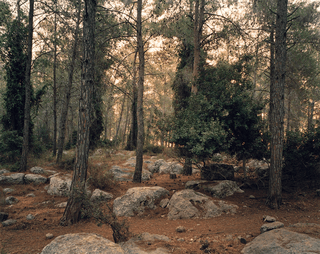
In 2005, Adam Broomberg and Oliver Chanarin visited forests that Israel has planted since its founding in 1948 with support from the Jewish National Fund. During the day, they are popular spots for family picnics – in the early morning, just after sunrise, the forests look serene and untouched. But all the places that Broomberg and Chanarin photographed once stood Palestinian villages. After the original inhabitants were forcibly evicted and their houses destroyed, the remains were gradually and deliberately covered with trees. When you look at the photos, you are not only looking at innocent pine trees, but also at a hidden history of destruction.